



The ACCESS (Advancing Chronic Care with Effective, Scalable Solutions) payment model is a new optional federal program under Medicare to test a payment model that reimburses physicians and technology vendors for technology-supported care management for chronic diseases such as high blood pressure, diabetes, chronic musculoskeletal pain, and depression. (Read PYA’s related article, ACCESS Payment Model: CMS Chronic Care Reimbursement Explained.)
ACCESS Co-Management Payments
The ACCESS model establishes co-management payments (CMP), which compensate eligible Medicare Part B primary care and referring providers for documented review and co-management services. Provider types, such as these, may bill for CMP:
- All physicians
- Nurse practitioners
- Physician assistants
- Clinical psychologists/psychologists billing independently
Read the full list of providers eligible to bill for CMP.
Federally Qualified Health Centers (FQHCs) and Rural Health Clinics (RHCs) will be eligible to participate in ACCESS beginning in October 2026. The Centers for Medicare & Medicaid Services (CMS) has indicated that additional guidance is forthcoming related to pharmacists and medical supply companies with pharmacists.
ACCESS Billing Process and Requirements
In order to submit a claim for CMP, the eligible provider must spend at least five minutes reviewing the patient’s ACCESS Care Update and perform one of the following activities:
- Adjust or reconcile medications
- Update the problem list
- Establish or modify monitoring or follow-up instructions
- Coordinate care among clinicians involved in the beneficiary’s care
- Communicate with the ACCESS healthcare provider
- Document clinical agreement or disagreement with ACCESS recommendations, including rationale
CMS pays 100% of the Medicare-allowed amount minus the sequestration reduction. Beneficiary cost-sharing does not apply to CMP, and beneficiary advance consent is not required.
Primary care providers can submit a claim to Medicare for CMP of $30 up to three times during a 12-month period, for a total of $90 during the period, plus an additional $10 if they assist the patient with onboarding. The payment for assisting the patient with onboarding can be billed only once per billing provider, per beneficiary, per ACCESS track. Clinicians may bill CMPs for multiple ACCESS tracks for the same beneficiary when distinct review and care-coordination activities are performed and documented for each track.
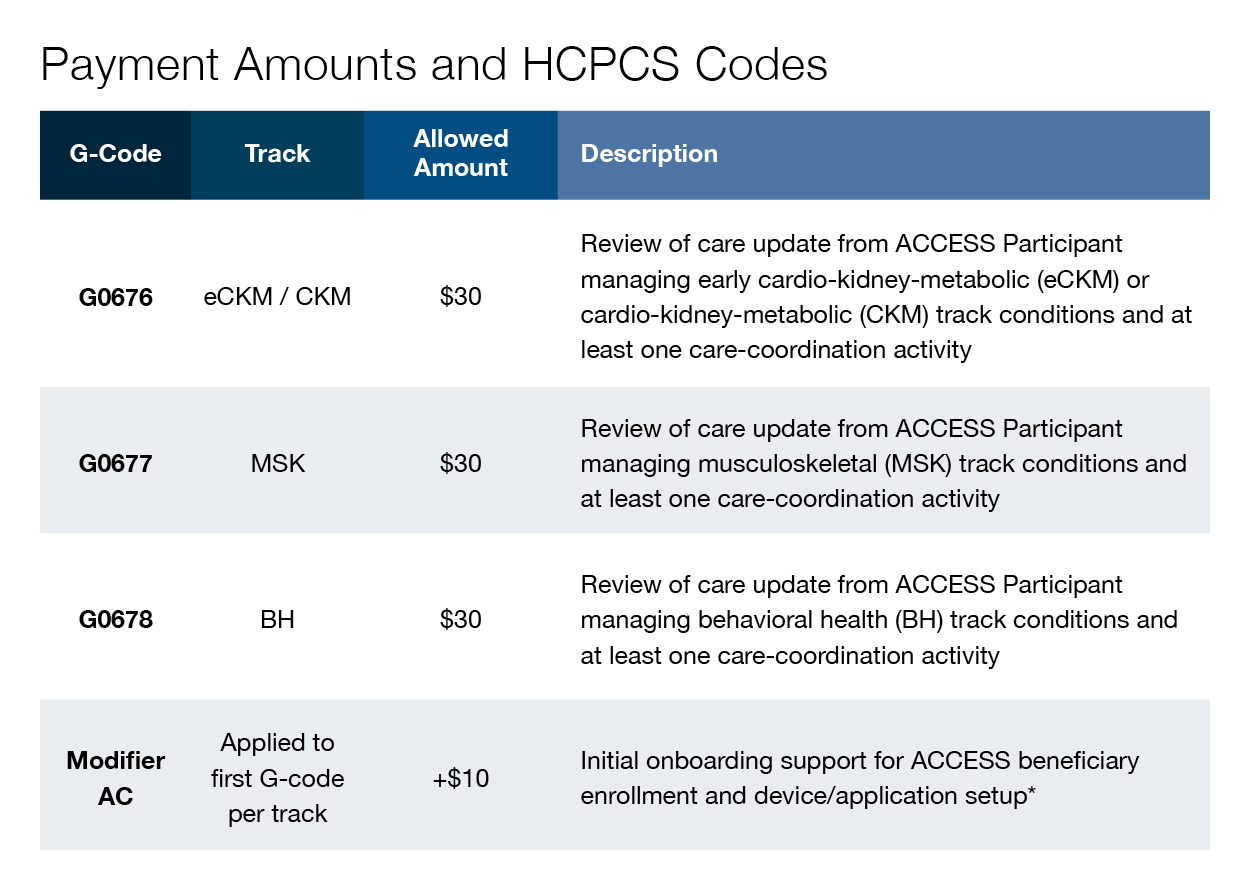
Read the table on the CMS website.
The date of service must correspond to the date on which the documented care-coordination activity occurred, and the place of service must be the practice setting of the rendering provider.
The diagnosis code must correspond to one of the qualifying conditions under one of the following ACCESS tracks:
- Early cardio-kidney-metabolic (eCKM) with qualifying conditions of hypertension or two or more of dyslipidemia, obesity/overweight with central obesity, prediabetes
- Cardio-kidney-metabolic (CKM) with qualifying conditions of diabetes mellitus, chronic kidney disease (Stage 3a/3b), atherosclerotic cardiovascular disease (ASCVD)
- Behavioral health (BH) with qualifying conditions of depression or anxiety
- Musculoskeletal (MSK) with qualifying conditions of chronic musculoskeletal pain
Key Takeaways
Providers should remember that documentation of the review of the clinical updates is required to support each CMP claim. Billing for CMP does not affect or replace any existing Medicare billing for office visits or other distinct covered services.
PYA’s Revenue Integrity Services team helps physicians and health systems understand and navigate complex federal and state programs, including how to compliantly perform and bill for ACCESS model co-management services. Our team can help you implement the model’s co-management billing guidelines and other aspects of the model.
We will continue to provide updates as more information becomes available.